Showing posts with label solar cells. Show all posts

7/22/2007

more heavy metals?

This isn't another post about metal bands, it's a celebration of my closet platinum acetylide fetish.[1] If you've been following CBC for a while, you already know that Excimer is much more friendly with organometallics and polymers than I am, but as with anything else, I'll make exceptions. Clearly I'm already OK with platinum. And apparently I'll read damn near anything on solar cells...So this brings us to a nifty little paper in Nature Materials.


One issue with these metallapolymers is that most of them to date have wide-ish bandgaps. While it's nice to be able to absorb lots of blue light, sunlight...isn't all blue. So crazy-wide bandgaps are not terribly useful if you're looking to take advantage of all the red and infrared light in the solar spectrum.


This brings us to the paper.[2] Apparently the donor-acceptor interactions between the cute little ring system and the icky (but tolerable because it is platinum) metal lead to a lower bandgap.[3] The weird thing about the compounds described here is that, unlike the other platinum-stuffed organic semiconductors out there, there's no emission from the triplet state. Usually, the heavy metal facilitates intersystem crossing between excited singlet state and triplet state.[4] Not in this case--the triplet energy is too low. This is explained here.


As far as device characteristics go, well, I'm assuming you can read, and I gave you the DOI.[5] The mobilities they give are less than impressive, but the power conversion efficiency for the best device was almost 5%.[6] There. That is your motivation to go and read about it. We will have a quiz tomorrow (kidding).

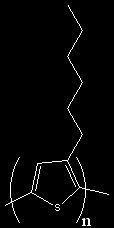
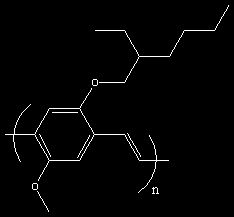
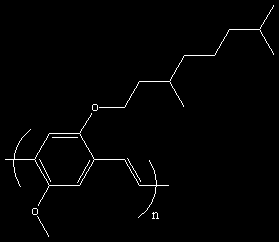
Added bonus: pretty colors! The authors happen to mention that the lovely polymer pictured above is purple and solvatochromic.

[1] I really can't write any further without telling you that Kirk Schanze is an absolutely kick-ass speaker. Said fetish is entirely his fault. If you see his name on a list of seminar speakers, you need to be there. I promise that everything he says will make sense and that you will not fall asleep.
[2] Blah blah blah I'm tired of writing lit posts. Three more weeks until I can start posting pictures of brightly colored compounds, guys. Start counting down the days...
[3] I have absolutely no idea how this works.
[4] ISC is "forbidden" by selection rules. "Forbidden" here carries similar weight to "speeding is forbidden," meaning that it isn't SUPPOSED to happen, but (as when driving where there are no cops) sometimes it does anyway.
[5] IF you are actually interested in those things. Since most readers are less than thrilled with device posts, this bit of blagging is solely intended to show off a nifty new compound.
[6] If devices made from MY compounds showed that kind of efficiency, you might see me skipping for the next few days. But...let's not go into that, since the only numbers I have for my stuff are so low I've blocked them out (as to avoid crying a little). This just means the engineers need to get to work and optimize everything to death...[7]
[7] You may have noticed that the footnotes to this post are almost as long as the post itself.
EDITED TO ADD: As Excimer has pointed out, I apparently can't count to four. Sad, isn't it?

6/19/2007

photoelectrochemical cells, quick & dirty

Alright, already. I wasn't planning on it, but there were enough curious comments on the last post that I'm actually going to tell you guys what that little device was.[1] However, I'm not in the lab now (else, I would be working and not writing, duh) so I'm short on notes and lit references (which are currently lying on my desk, in the lab...where I am not). Soooo...this is the quickie version from off the top of my head. Sadly, I have no pictures for you here. Feel free to correct me. (Especially YOU, Dave. Or YOU, Lakshmi. Or anyone else, really.)
Remember all those posts from a while ago on solar cells?[2] Well, I've been meaning to do a post on Graetzel (dye-sensitized) cells as well. Not that I've ever worked on them, but they're pretty cool. There's a back electrode (read: not transparent), and usually there's a lot of nanocrystalline TiO2 in them. This functions as an n-type semiconductor. Attached to the nanocrystalline titania is a dye. The "nanocrystalline" bit here is important--it provides a higher surface area for dye adsorption. Since titania's bandgap is too high to have much to do with absorbing sunlight, the dye is rather useful. After all, if it's a dye, it's not white like TiO2, so it's absorbing something, somewhere in the visible spectrum. Often, the dyes used for this purpose are ruthenium complexes, although price concerns may drive the development of alternatives. Usually there is some carboxylic acid functionality present, which enables the dye to adhere to the titania. Other (frequently oxide-based) semiconductors can be used in place of titania, which has the associated problem (advantage, maybe, elsewhere?) of nibbling on organic things.
So the dye absorbs light, and transfers an electron to the titania. And then...yeah, pretty much nothing, until I mention the electrolyte that is essential to the functioning device. What's generally used is I-/I3-. This, along with the front electrode, provides a cute little redox shuttle to restore the dye to its original state.
As I said, no pictures, since I have never made one of these and am not in the mood to Photoshop a nice little figure for other people to steal.[3] However, if you're interested, there are instructions for DIY dye-sensitized solar cells on the cheap here. Things like this are especially nice for outreach (HINT HINT).
Back to the original purpose of this post (which has thus far been neglected), the nanopopsicle I showed you a few days ago is not, in fact, a Graetzel cell. It is similar, though--the major difference is that the semiconductor used in my little device has a sufficiently low bandgap to absorb light in the visible spectrum.[4] That, and all the materials are completely different. The only appearance carbon makes in the nanopopsicle is in the insulating coat of epoxy.
Speaking of which, epoxy is not such a terrific thing for XPS, so I would be thrilled if someone had other quick & easy ideas for an alternative.

[1] In the early days of CBC, no one said much of anything to a device post. I know many of you are just bored synthetic chemists looking to see neat little structures, but...when there are no comments, we get lonely. And we stop doing device posts. Have the audience members experienced a change of heart?
[2] I'm not terribly satisfied with it, so a follow-up may be in the works. You have been warned.
[3] Not that you would want to, but anything of mine that appears on CBC is free for the taking as long as I am credited (and, yeah, it would be nice if you let me know you were going to use it).
[4] Never mind, y'know, all that infrared light from the sun. Bandgap's not THAT low.

4/26/2007

every now and then we need a serious post

I was searching for something-or-other recently and came across an interesting review by Jean Fréchet. It had all sorts of familiar structures.[1] I was very excited and knew I had to mention it here. But then I noticed some of the other articles. I'm about two weeks late in spreading the word, since it isn't something I usually read, but the current issue of Chem. Rev. (vol. 117 issue 4) is ALL ABOUT ORGANIC ELECTRONICS. (All apologies, but that totally called for screaming capital letters.) So, if you happen to read CBC but have no idea what the hell we're talking about unless it involves synthesis, here is a chance to become un-confused.[2, 3] I really have to point you to this one, maybe because I'm a photovoltaic fiend. I haven't had the chance to get through it yet, but every paper I've seen with Sariciftci's name on it has been extremely accessible and undergrad-friendly.

In other words, you should stop reading this and go read that.


[1] By "familiar" I mean I see some of them at least once a week in group meetings, and if I hear anything else about them, I might go nuts.
[2] I know there are several bloggers out there who fit this category. You know who you are!
[3] Is un-confused a word? I don't think it is, but it fits, so I'll use it.

1/10/2007

what's in the flask:

Yesterday's mystery flask managed to confound pretty much everyone who guessed. Surprise, surprise: here's the reaction.

Here's a shot of the flask before the reaction with everything in there except the amine.

I know what you're thinking. "Dude, where's my solvent?" Everything is solid! ...At room temperature. The reaction is actually run at between 105 and 140 or so degrees, depending on the boiling point of the amine. Stick a septum on, blow nitrogen through it like crazy and inject the amine. This throws off water vapor, so pressure will build up. If you're not careful, you will hear a *POP* and rush over to see your septum off to the side. Folding it down and using a piece of wire to hold it in place seems to work well, but keep an eye on the bubbler. The lovely white crystals from yesterday's post can clog the needle.

The workup (which is simple but also a pain in the ass) and the rest of the procedure is detailled in this paper. As an added bonus, there's a bit about solar cells in there![1]

Beautiful reaction. It's never failed me. The only downside is that you should keep a LOT of chloroform handy, if you ever want your glassware to be clear instead of reddish in places.[2] Oh, and on this note, be sure to keep R long and greasy.


[1] Sadly, as is stated in the abstract, the solar cells they tried to make with these didn't quite work. Maybe sometime I'll have something to say about electrode interfaces. For the moment, though, I'd rather leave that one to the surface chemists and the engineers.

[2] Particularly if there are ground glass joints involved.

12/28/2006

a new approach to solar cells?

This paper has been out for a while, but I've been meaning to write something about it anyway. Most organic solar cells use nice, normal carbon-based compounds as donor and acceptor materials. While some of these have decent charge carrier mobility ("decent" is a relative term!), there is another important factor to consider--the exciton lifetime. This is the amount of time the exciton can last before recombination. Recombination occurs when the electron and the hole annihilate each other. This may or may not involve release of a photon. (In OLEDs, recombination is the desired outcome. Not so for solar cells.)

Photoexcitation will give a singlet exciton. ΔS=0, no spin flips with excitation, right? In most light-atom-only (read: organic) compounds, L-S coupling is observed, and ΔS=0 holds. For heavier atoms, spin-orbit coupling takes over. Consequentially, ΔS=0 doesn't matter so much.[1] This enables intersystem crossing to a triplet state...which is cool, because triplet excitons last a lot longer than singlet excitons.[2] Increasing the exciton lifetime also increases the exciton diffusion length. This means the solar cell can be thicker! If it's thicker, it can absorb more light.

This is the rationale behind using Pt-OEP. A heavy metal, such as platinum, enables spin-orbit coupling. In other words, the excitons used by the solar cells in the aforementioned paper are triplets! Unfortunately, Pt-OEP has a very low charge carrier mobility and doesn't absorb at all the wavelengths emitted by the sun.

Still, the paper's worth reading if you haven't gotten around to it already (it was published in 2005).

[1] The first rule of quantum is: the rules don't always apply. Forbidden transitions still occur.

[2] Never mind that spin-orbit coupling affects this also...

11/01/2006

Organic solar cells in plain english--part three

In order to explain why organic solar cells don't last so long, a little chemistry background is in order. As I said in Part One, most carbon-based semiconductors are p-type materials.[1] These can be polymers or smaller molecules. P3HT, MEH-PPV, MDMO-PPV ...the list goes on.


Hmm, what do these have in common? Alkyls or alkoxies on an aromatic ring? These are swimming in electron density.

This can be a bit of a problem if you have the solar cells open to air, especially considering that they contain these fluffy-with-electrons polymers next to C60. C60, in addition to being a decent material for use in the active layer of a solar cell, is also a photosensitizer. Oops.

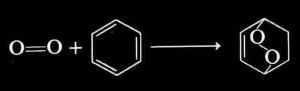
[2]Photosensitizers (P) are materials that absorb energy from light. The energy they absorb puts them in an electronically excited state (P*). P* can then react with other materials, say, O2, to produce O2*, infamous as singlet oxygen.[3] Uh-oh. Singlet oxygen is hella reactive. Unlike ground-state oxygen, it can readily oxidize organics.

Think of it as a shark, but moreso after electrons than blood.


So you get a 1,2-dioxetane, which usually ends up as the ketone, or an endoperoxide, which ends up as the quinone.[4] Apply this to the aforementioned electron-fluffy polymers, and you get...a dead solar cell. Sadness.
Another way to kill your carbon-based solar cells is to expose them to moisture. The PEDOT:PSS layer is hygroscopic. After the PEDOT:PSS adsorbs a little water, the device becomes resistive.[5]
There you have it--things that kill solar cells. The best way to get around this at the moment is to encapsulate the devices so that oxygen and water (well, humid air) can't get to them. Granted, that's more an engineery thing. Chemists are in it to make more stable materials...which is kinda tricky. Maybe I'll post more of this. Maybe not.

[1] Unless you are Tobin Marks, in which case you have oligothiophenes with fluorinated alkyl or aryl stuff stuck on. Check out JACS 2005, 127, 1348-1349 for one example.
[2] Unlike solid-state physics, I would KILL to get into photophysics in more depth. But this is still in plain english. A promise, though: Catastrophe aside, you WILL see more photophysics in here, with gory details to accompany.

[3] Mwahaha!
[4] Well, it won't quite work with the substrates I have shown...singlet oxygen reactions usually require CRAZY electron density.
[5] Solar Energy Materials & Solar Cells 2006, 90, 3520-3530. Can I just say that it's nice to read a paper every once in awhile that I can get through without having to reread every other line because the writing is overly thick and technical? Thank you very much to the authors. Ahhhh.

10/30/2006

Organic solar cells in plain english--part two

Alrightie. Knowing how the organic solar cell is made and how it works[1] allows us to figure out how to make it work better. In order to build a better solar cell, though, it might be a good idea to figure out what's wrong with the ones we're making now.


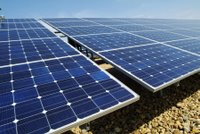
Here's a shot of a rather large solar array, courtesy of DuPont. Of course, these are crystalline silicon, which is not terribly interesting (to an organic chemist). Apart from the obvious problem of not being carbon-based, silicon is DAMNED EXPENSIVE, because it's also used for so many other electronics applications. Scads of demand for silicon. Also, you have to take into account that the silicon has to be processed in order to be useful. (What's in this picture is not useful.)


The equipment needed to process it is also DAMNED EXPENSIVE. In order to be useful, it has to be extremely pure. Carbon-based materials, likewise, also have to be pure in order to be useful. Otherwise, there are traps, which stabilize the charge carriers (electrons? holes? remember?)...if the charge carriers are stabilized by something in a particular spot, they become localized, and they don't move[2]. Low charge carrier mobility means your device does not work so well. Organic materials, unlike silicon, are not so hard to purify (unless you are required to purify something for an undergraduate lab course). You certainly don't need a clean room for it. Carbon-based materials are also not DAMNED EXPENSIVE (arguably).

So why are we still using silicon in solar cells? Well, first off, the record efficiency for an organic solar cell is 4.4% (please, please correct me if I'm outdated). Silicon-based photovoltaic efficiencies can be as high as 30-something%. (Ouch. But we can sorta blame that one on the engineers.) But this isn't the biggest drawback for carbon.
Think about the solar panels normal people see on a daily basis. How often have you had a calculator die because its little solar strip quit working? Never? Even after years and years of abuse? There it is. Organic solar cells die young. Device lifetimes are really pretty miserable at this point.
Or: Device lifetimes would be a lot better, if we kept them under dry nitrogen forever and ever...and maybe in the dark as well...
You'll find out why in the next post. It's really too exciting for me to cut short, and I don't really want to make today's update four times longer than it is already.


[1] Um, well, we know how to make them...how they work is a matter of contention at the moment. But it's more exciting to find out you're wrong than to be right, isn't it?

[2] Sorry, but "in plain english" means I don't have to go into solid-state physics. While I can translate chemistry to english, I can't do the same for physics.

10/29/2006

Organic solar cells in plain english--part one

Solar cells of the cheap plastic variety (carbon rather than silicon) are "up there" in my long, long list of side interests. There are some obvious problems, though. While this is nice for those of us who like to research them (can't study something if it's already perfect), it's not so nice for commercial applications. Solar cells that are flexible or that can be sprayed on are cool as hell, but no one will buy them (save for hardcore gadget nuts) if they only last a few days or so. In the next few posts, I'll attempt to explain in straight english how these things fall apart. Shockingly low efficiency is another issue for another post as well, maybe. First things first. How does a solar cell work?

First, let me clarify that I'm only talking about a specific kind of solar cell. Most people are familiar with the silicon-based cells in their calculators and elsewhere. There are also hybrids and dye-sensitized (Gratzel) solar cells, which are cool, but my carbon fixation leads me to focus on these, the all-organic kind.

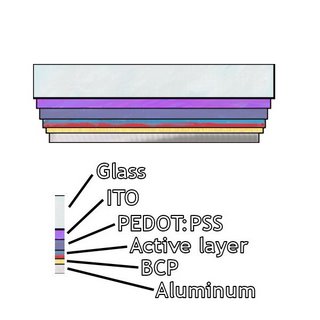
Here's a picture of a typical device. ITO/glass is pretty standard and is used by most people. ITO stands for indium tin oxide. Being both transparent and conductive makes it attractive for use as an electrode in a solar cell. PEDOT:PSS is a conductive polymer used as a hole transport layer. The active layer contains a donor (p-type material) and an acceptor (n-type material). The acceptor is usually C60 or PCBM (derived from C60). The donor gets a lot of attention, and there are a number of materials that have been developed to serve this purpose. BCP serves as an electron transport layer, but other materials can be used instead. Aluminum is the other electrode. Silver or calcium can substitute here.

So how do you get energy out of these? The active layer is where the photoinduced charge transfer takes place. Photoinduced charge transfer involves light--a photon enters the active layer and creates an exciton (electron-hole) pair. The electron diffuses to one electrode and the hole to the other. There you go--a voltage difference between the electrodes. For those of us who don't remember physics, the voltage difference is crucial if you want to be able to use your solar cell to power anything. What do you call a battery with no voltage difference across the terminals? Dead.

Correct me if I'm wrong. Please?

Next time: more about the active layer, and the eeeeevils of oxygen.