Showing posts with label oxygen. Show all posts

2/16/2007

something I didn't know

Given my fascination with singlet oxygen, I absolutely have to direct you to this post on Khymos. Chemists who are also into homebrew should definitely check this out!

It's been a while since I looked at anything oxygen-related. Maybe soon I'll branch out from materials just a little and put something up on photodynamic therapy.

12/22/2006

oxygen--part two


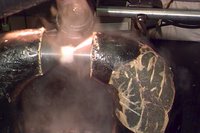
Back to something I started a while ago and didn't finish: how to generate singlet oxygen. Probably the best-known means is photosensitization--use a dye (Rose Bengal, Methylene Blue, etc.) and a lamp. The dye is photoexcited and transfers its energy to oxygen, giving the singlet.[1] While this can involve some pretty cool-looking lamps (see left), it doesn't have to--you can do it Dylan's way with a lamp from Home Depot. (This group has even managed to do it without solvent!) Photochemical reactions can have some scale-up issues, though, despite being super-cool.

Alternatively, you can use peroxide and things involving metals (ew, metals, ick). Molybdates, peroxotungstates and La(OH)3 seem to work alright.[2] CaO2 appears to be the most popular, but it sounds kinda tricky to make. (Anyone done this?)

And then there's a fun little reaction I did a while ago.[3] Uses a weird little hypervalent iodine compound--[Bis(trifluoroacetoxy)iodo]benzene, oft-abbreviated as "PIFA"--and catalytic H2O2 to generate singlet oxygen.

This was dead easy to set up and about the only thing I've done that's given a respectable yield. If a knuckle-dragging undergrad like me can manage not to screw this up, just about anyone can. As an added bonus, the benzofuran I started with was the color of yellow highlighter ink. (No picture, though. Sorry!)


[1] You really don't want to get me started on energy transfer, especially since I am already very excitable. Maybe a nice long post will appear about it in the future.

[2] Found a review on this a while back. Fairly short & sweet. Have fun.

[3] Here is the paper! Go try it! (Especially if it's a bad day and nothing else is working. This will make you feel better.)

11/09/2006

oxygen--part one

I mentioned singlet oxygen a while back in the context of solar cell materials. However, I didn't get to go into specifics, and unlike solid-state chemistry (which is too close to solid-state physics for my tastes), photochemistry is among my current obsessions. While I can't quite put this in completely plain non-chemist English, I think I can make it manageable for chemists who can't do quantum.


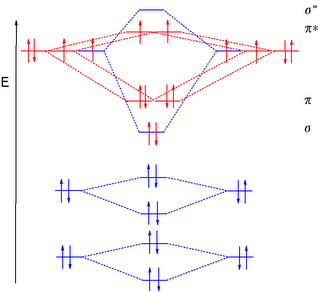
Oxygen in its ground state is a triplet. Spectroscopic notation: ³Σg- This is a consequence of its degenerate HOMO energy levels. (Nice diagram from Wikipedia, but why isn't it in the article about oxygen?) Focus on the two electrons in the pi-antibonding orbitals, OK? Their spins are parallel. This makes oxygen paramagnetic. I know SOMEONE has to have seen this demonstration, since the Physics department at Brown University has such a good picture of it.

You know, the one where you pour liquid oxygen over the poles of a really strong magnet...and it sticks? Looks like a little donut? (By contrast, if you do the same thing with liquid nitrogen, nothing this exciting happens.)

Back to the orbital diagram. Look at the pi-antibonding electrons. Imagine "flipping" one of them so that the spins points the other way. This is the ¹Σg+ state. While it is a singlet state (note the "1" multiplicity instead of the "3" for the ground state), it's actually the second excited state. This one actually doesn't get much consideration, because it decays so quickly to the first excited state that there isn't time enough for it to do anything interesting.

So what are the electrons doing in the first excited state? Back to the pi-antibonding electrons in the diagram. Now visualize putting both of them into the same orbital and making the spins antiparallel. This is ¹Δg oxygen. It is what's commonly referred to as singlet oxygen.

Why does this matter? Think of most organic compounds in their ground state. Absorbing a little light in the UV or visible range will immediately kick them up into an excited state. Of course, most organic compounds (radicals and triplet weirdos excluded!) are ground-state singlets, so their electrons have paired spins in the first place. And the excited state they reach when you add light is also a singlet. This is not accidental. It's also something oxygen can't do. This is because there are NO SPIN FLIPS DURING EXCITATION! As a consequence, triplet oxygen cannot be directly excited to the singlet state. (This is good news for us, since reactive oxygen species are not beneficial to our continued living.)

Next: how is singlet oxygen produced?

11/01/2006

Organic solar cells in plain english--part three

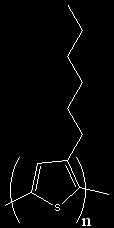
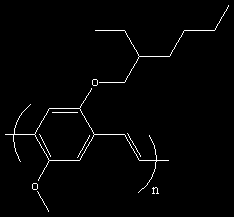
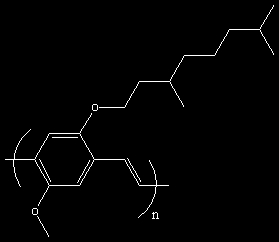
In order to explain why organic solar cells don't last so long, a little chemistry background is in order. As I said in Part One, most carbon-based semiconductors are p-type materials.[1] These can be polymers or smaller molecules. P3HT, MEH-PPV, MDMO-PPV ...the list goes on.


Hmm, what do these have in common? Alkyls or alkoxies on an aromatic ring? These are swimming in electron density.

This can be a bit of a problem if you have the solar cells open to air, especially considering that they contain these fluffy-with-electrons polymers next to C60. C60, in addition to being a decent material for use in the active layer of a solar cell, is also a photosensitizer. Oops.

[2]Photosensitizers (P) are materials that absorb energy from light. The energy they absorb puts them in an electronically excited state (P*). P* can then react with other materials, say, O2, to produce O2*, infamous as singlet oxygen.[3] Uh-oh. Singlet oxygen is hella reactive. Unlike ground-state oxygen, it can readily oxidize organics.

Think of it as a shark, but moreso after electrons than blood.


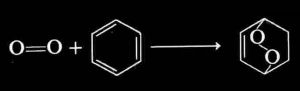
So you get a 1,2-dioxetane, which usually ends up as the ketone, or an endoperoxide, which ends up as the quinone.[4] Apply this to the aforementioned electron-fluffy polymers, and you get...a dead solar cell. Sadness.
Another way to kill your carbon-based solar cells is to expose them to moisture. The PEDOT:PSS layer is hygroscopic. After the PEDOT:PSS adsorbs a little water, the device becomes resistive.[5]
There you have it--things that kill solar cells. The best way to get around this at the moment is to encapsulate the devices so that oxygen and water (well, humid air) can't get to them. Granted, that's more an engineery thing. Chemists are in it to make more stable materials...which is kinda tricky. Maybe I'll post more of this. Maybe not.

[1] Unless you are Tobin Marks, in which case you have oligothiophenes with fluorinated alkyl or aryl stuff stuck on. Check out JACS 2005, 127, 1348-1349 for one example.
[2] Unlike solid-state physics, I would KILL to get into photophysics in more depth. But this is still in plain english. A promise, though: Catastrophe aside, you WILL see more photophysics in here, with gory details to accompany.

[3] Mwahaha!
[4] Well, it won't quite work with the substrates I have shown...singlet oxygen reactions usually require CRAZY electron density.
[5] Solar Energy Materials & Solar Cells 2006, 90, 3520-3530. Can I just say that it's nice to read a paper every once in awhile that I can get through without having to reread every other line because the writing is overly thick and technical? Thank you very much to the authors. Ahhhh.