Showing posts with label xtals. Show all posts

10/23/2007

orange!! (the most exciting thing i've seen in a while)

You've seen a lot of the perylene diimides I've made. (In case you missed them, here they are.) To this point, they've all looked the same--red to violet in the solid state. This one is different. It's so tangerine it hurts a little. Also, it isn't a fibrous pancake--all the others give me long, flexible needles, if they crystallize at all (perylenes are infamous for gellating). This one actually behaves like a normal crystalline solid! And it's sparkly! See?


Why orange, though? This is neatly explained by quantum interference effects in a super-cool but somewhat ancient paper by Roald Hoffmann and friends. (Do not fear the theoreticalness, undergrads and synthetikers. It's an easy read--very clearly written. I'd kill to see more like this in the literature.)

I'll say first that the black PDIs they report sound really exotic and I kinda wish mine were that color.[1] One of the more interesting conclusions of the paper is that the dyes with the most substantial band-broadening in the solid state are the ones with the highest photosensitivities. Cool, eh? I won't say too much more about crystallochromy, since the paper discusses it so much more nicely than I could if I tried, so...just read it?[2]

Since--as Kazmaier and Hoffmann state--the color of these compounds depends on their crystal packing, and this derivative is a markedly different color than anything else I've made, I'd KILL to see a structure of it. Of course, crystal growing takes time, so I'll be patient.

Also, keep an eye on CBC. We're planning something REALLY COOL! We just can't tell you what it is yet. ;)

[1] Black is a super awesome color if you're trying to make solar cells. Black with significant near-IR absorption is even better. Black leather with spikes is good for BDSM and death metal.

[2] For another, more recent, nifty paper on dye aggregates, check this out. Someone covered it already. I tried to find their post, but...I read a lot, and I've forgotten who pointed it out. Care to correct my memory?

10/18/2007

change of plans? (no-content post)

I was planning to post some beautiful red crystals that finished growing after two weeks of resisting the temptation to look at them every five minutes. You would have liked them--they were fibrous and tangled and somewhat reminiscent of hair. Some are shorter and more blocky, and look like they will diffract very well. Unfortunately, I don't have them anymore, and unless some nice people at NIST want to take a shot of them once they arrive, you'll never see them. Sorry!

9/24/2007

if i go too long without posting i feel lazy


...so here's a picture. Yes, it's a rather boring yellow-brown color, which means, in my lab, it must be a synthetic intermediate of some sort and not a final product. I've never seen anything that gave the little swirlies like you see here, though, which is why it deserved a picture. Unfortunately, I don't know exactly what this IS yet, but it should hopefully get shot into the GC/MS tomorrow.
It's always nice when something crystallizes on the rotavap--lets you know it's squeaky clean. I know someone here who was extremely lucky and got single x-rayable crystals from the rotavap. Wish I had awesome crystal karma like that.
Oh, and speaking of lazy, where are your entries for the lolnano contest??? We've received a few, and they're pretty funny, but they're terribly lonely and would like more friends. Yes. We require more submissions! Mwahaha!

8/22/2007

serendipity?

I'm terribly unlucky with growing crystals, as I think I mentioned before. That is to say...I can grow them, I just can't do it on demand. When I took off for the summer, I left a few vials full of solvent and other goodies sitting around under the bench, and when I came back, the structures were solved.[1]

Along with the "accidental" method of crystal growth, there is also the "leave-it-in-an-NMR-tube-and-forget-about-it" method. I'd never seen it work until I peeked under my bench this week and saw this spiky little guy.


Of course, most of what's in there looks like crud, and I know the sample wasn't the cleanest stuff in the world, but hey! It's still crystalline. Not terribly useful, though, as it's an undesirable byproduct.[2] Oops.

I could show you more red-orange crystals, but I'd rather end with something bright blue that's been sitting on the shelf above my bench for over a year or so. I didn't make it, and the guy who did has pretty awful handwriting (AARGH!) so I'm not entirely sure what it is. Methinks there's copper in there, though.


Enjoy the pictures. There are more coming.[3]


[1] SCORE!!!
[2] If I work for you and I'm wrong, feel free to throw it to the x-rays. But that's the only crystal-looking thing I have of that compound, and the intended product is probably more useful.
[3] ...because I'm back to making colorful things, and because a fluff post is always easier to write than a real post with content. You know better than to expect actual content in a CBC post, right?

5/27/2007

surprise!

Sorry, Excimer. I was going to do a post on something else, but then I got to the lab today...and found these!

Please pray to the crystal gods for Ψ*Ψ.
Surprise crystals are maybe the best kind of surprise ever. The only thing that really comes close is surprise money...if it's more than $20.[1] Kyle did a post a while back on growing crystals, but he failed to mention the only method that has seemed to work for me thus far. See, whenever I make a conscious effort to get something x-rayable, I think my compounds realize it. And then they laugh at me and aggregate or powder out or gellate. It's a little depressing. Almost all of my intermediates crystallize if I so much as look at them funny. The things I want x-ray structures from? No cooperation whatsoever...unless I am not seriously trying.
I advocate the accidental method of crystal growing. The last thing that worked was left after a mess of solvent evaporated--it was solvent I had used to rinse the glassware I was working with. Still can't remember exactly what was in there. Then there are the pretty red things in the picture (which, since I am excited about them now, will probably give lousy data). Those came out of the first solvent I tried. I didn't think it would work. I like being wrong sometimes.
[1] "Surprise money" refers to cash you forgot about and later found in the couch, your freshly washed pants, etc.

4/07/2007

solid-state synthesis: sans solvent?

Stuart at The Sceptical Chymist recently did a quick interview with Mike Zaworotko, so I'll continue what he started and point you in the direction of a recent paper in Crystal Growth & Design.[1]

The idea behind it is C3S3, which is a much faster way of saying co-crystal controlled solid state synthesis. Naphthalenetetracarboxylic dianhydride (NTCDA) and an amine were ground together with maybe a drop or two of solvent thrown in. Heating gave a co-crystal of the two. The co-crystal was then heated like crazy to give the corresponding diimide.


I'm guessing that the product was not so soluble, which might explain why they recrystallized using DMSO or DMF. I'm pretty sure the corresponding perylene diimide would be brickdust. Still, greasy amines (with looong alkyl attachments) would probably be too volatile for this.

In any case, it's an interesting little paper that caught my eye, and I needed to post something, so here it is. You might expect to see more crystal engineering-related lit on CBC in the next month or so, by the way, since I've been staring down a few of those papers lately.

[1] It has to be pure coincidence that everyone covered in Sceptical Chymist's Reactions so far is doing something I find interesting. I will attribute this to Stuart's fantastic taste in subjects rather than mind-reading.

3/05/2007

now accepting mojo donations

I like to take pictures in the lab. (This should be painfully obvious to anyone who has been following this blog.) Fortunately, I have a nice variety of subjects, because most of what my labmates and I make is unusually vivid. On any given day, I could walk in and find a solution for every color of the rainbow. It wouldn't be hard to mistake a random something-or-other on the rotavap for Kool-Aid.[1] It's a safe bet that most organic chemists don't see these things on a regular basis. Those who do are awfully quiet as far as blogging goes, so I'm guessing that very few people appreciate just how troublesome highly fluorescent compounds are for the camera. Granted, not everything poses this problem. If they don't absorb camera-flash, it's a non-issue.[2] This is true for most garden-variety boring white-to-yellow organics. There's also not a problem if the flash-induced glow is close to the solution colour, which is the case for the perylene diimides I've worked with.


Right now, the solution pictured above is the one that's giving me problems. I could show you the nearly-opaque red stuff I see when I turn the flash on, or I could show you the dark blue solution I see when I turn off the flash and hold it so that the light shines through it. It's almost iridescent in appearance--most of the time, it's not all blue or all red but a blend of the two. You can see this below, but the camera definitely doesn't do it justice. The camera also doesn't show just how much I've abused the TLC pencil in the picture. A bit of it remains stuck on the bench.

After the dichloromethane shower, it doesn't click anymore.
Photography is still a side interest of mine, though, and thus not deserving of too much complaint. The most irritating thing about the above solution is that I'm trying to grow crystals from it. I didn't know this wasn't easy. It sounded easy.[3] But I'm after sizable, high-quality single crystals suitable for x-ray diffraction. It appears that growing these is more voodoo than science.

Please share your crystal mojo. I need it.

[1] In the lab, as in any self-respecting suicide cult, those who are there of their own free will are necessarily insane. Don't drink the Kool-Aid!

[2] This has me seriously wondering about the spectrum of light emitted by camera. Most things that fluoresce under long-wave TLC lamp seem to fluoresce under camera-flash...

[3] I'm good at being wrong.

1/09/2007

mystery flask!

Tonight, I bring you pictures! Bonus points if you can guess what's in the flask before I post it tomorrow! [1]

Side view of the mystery flask


Top view

As an added bonus, and because the muppet bloggers at Two-Headed Chemical Mayhem have been quiet lately, the mystery flask comes with CORK RING!

[1] Yeah, I'd do this tonight, but I definitely left the reference in the lab. Oops!

12/19/2006

crystals!

Lately there has been some talk about the importance of crystallography on Whistling in the Wind and Chemical Musings. While some interesting points about modeling in general and drug design in particular come up, some of us who are less interested in pharma-chem are still in need of crystallographic data.
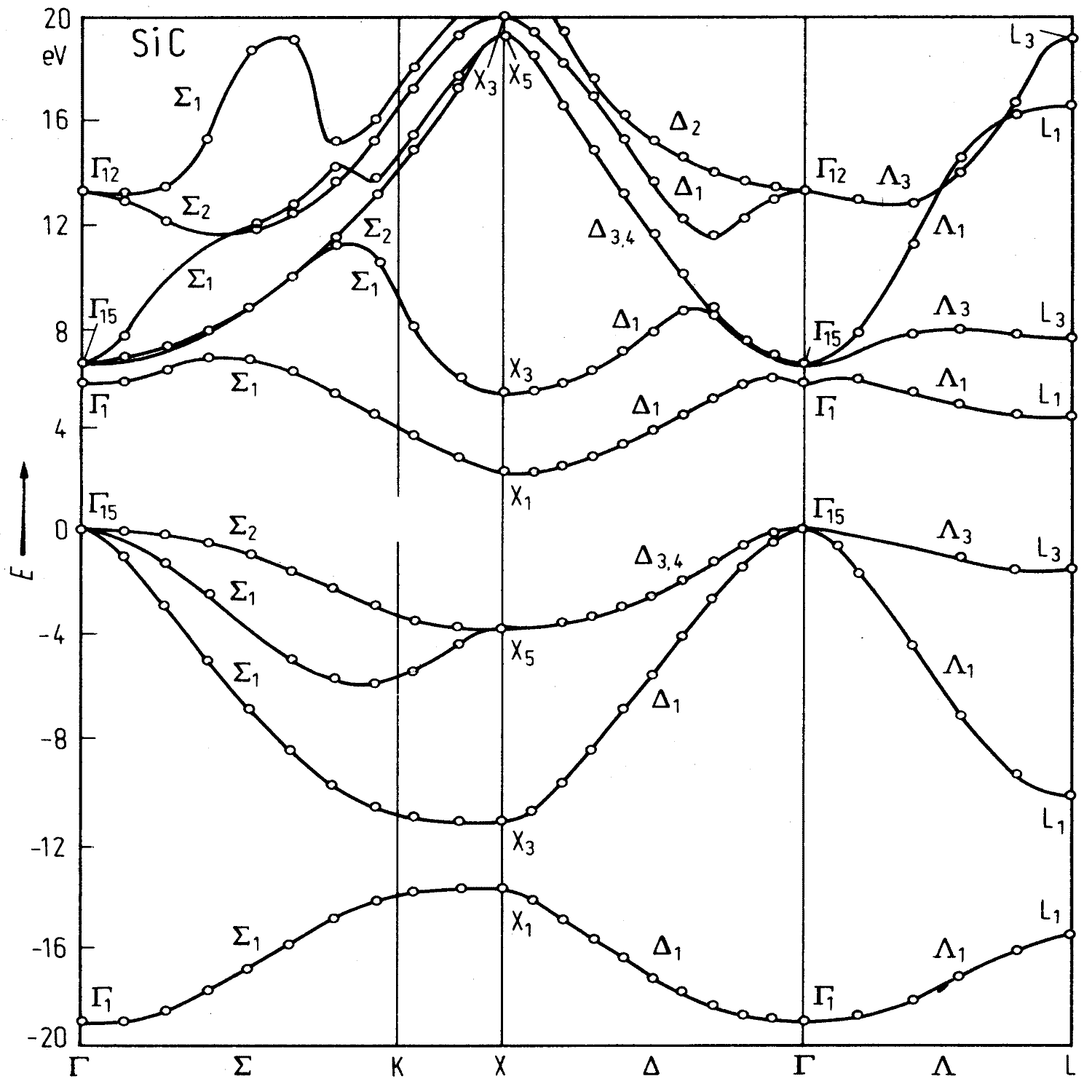
Semiconductors, the molecular love-children of people who design materials for use in devices such as transistors (and solar cells and OLEDs and others), have electronic properties that are closely related to their crystal structures.[1] Charge carrier mobility in crystals of organic semiconductors depends on the crystallographic axis along which the mobility is measured. In other words, if you're trying to build a single-crystal transistor, you had better have a crystal structure so you can tell how to orient the thing for highest mobility. More importantly, the band structure of a semiconductor depends on its crystal structure. (Although I would really like to go into more detail here, k-space really hurts my head.) I will probably elaborate on this topic after a semester's worth of crystallography. Until then, ask your local crystallographer or solid-state physicist, or consult the Britney Spears guide to Semiconductor Physics.

Have a picture. Here's the band structure of silicon carbide (not organic, but good enough as an example of sorts.)

mband_3C_SiC


[1] Polymers are an exception of sorts, since they are too weird to have regular crystal structures...