Showing posts with label cool papers. Show all posts

10/23/2007

orange!! (the most exciting thing i've seen in a while)

You've seen a lot of the perylene diimides I've made. (In case you missed them, here they are.) To this point, they've all looked the same--red to violet in the solid state. This one is different. It's so tangerine it hurts a little. Also, it isn't a fibrous pancake--all the others give me long, flexible needles, if they crystallize at all (perylenes are infamous for gellating). This one actually behaves like a normal crystalline solid! And it's sparkly! See?


Why orange, though? This is neatly explained by quantum interference effects in a super-cool but somewhat ancient paper by Roald Hoffmann and friends. (Do not fear the theoreticalness, undergrads and synthetikers. It's an easy read--very clearly written. I'd kill to see more like this in the literature.)

I'll say first that the black PDIs they report sound really exotic and I kinda wish mine were that color.[1] One of the more interesting conclusions of the paper is that the dyes with the most substantial band-broadening in the solid state are the ones with the highest photosensitivities. Cool, eh? I won't say too much more about crystallochromy, since the paper discusses it so much more nicely than I could if I tried, so...just read it?[2]

Since--as Kazmaier and Hoffmann state--the color of these compounds depends on their crystal packing, and this derivative is a markedly different color than anything else I've made, I'd KILL to see a structure of it. Of course, crystal growing takes time, so I'll be patient.

Also, keep an eye on CBC. We're planning something REALLY COOL! We just can't tell you what it is yet. ;)

[1] Black is a super awesome color if you're trying to make solar cells. Black with significant near-IR absorption is even better. Black leather with spikes is good for BDSM and death metal.

[2] For another, more recent, nifty paper on dye aggregates, check this out. Someone covered it already. I tried to find their post, but...I read a lot, and I've forgotten who pointed it out. Care to correct my memory?

10/19/2007

Friday Potpourri

Just a few things to sate your appetite for the ol' CBC this weekend:


  • James Watson, as it turns out, is a complete prick. Shocking. Given his treatment of Rosalind Franklin in The Double Helix, frankly nothing that comes out of this man's mouth surprises me- he's always had a lack of tact. The concept of "race" is a purely socioeconomic one, which has a long, sordid, awful history in this country. No amount of science is going to fix that. If Watson has his way, such science would only make things worse.


  • I think this is a point worth repeating. There are some things that science can't fix. Race discrimination is undoubtedly one of those things.

  • Roger Kornberg does chemistry! Who knew? *epic lulz* In an incredible paper that came out in Science this week, the Kornberg group isolated and got a crystal structure of a gold nanoparticle with 102 Au atoms capped by 58 mercaptobenzoic acid ligands. Given the difficulty of generating sufficiently monodisperse nanoparticles to even make crysals, this is quite an achievement. A great read! (thanks to anonymous for the tip, whoever you are.)


  • Another cool paper from Advanced Materials, aka that one journal with the awesome research and no supporting information: the Japanese have succeeded in fabricating a gel that walks. On its own. Using metal redox chemistry and no biologicals. I, for one, submit to our walking jelly overlords, which I suspect will take over Japan, and soon the world, in the next twenty years.


  • In the "yet another paper on carbon nanotubes" department, a Nano Letters paper from the Burke group at UCI, where they made a carbon nanotube radio. The nanotube acts as the AM demodulator of the radio source, and they even made a video demonstrating how it works with those newfangled iPods all the kids have nowadays. The music choice is pretty dumb (it was like muzak or something- why not some real music?), but the concept is cool.


  • EDIT: The video is on YouTube! woot


  • And finally, in the self-congatulatory deparment, an article in this week's Science about this year's Nobel Prize in Chemistry going to Gerhard Ertl has the following quip:

    "In an earlier phone interview with Science, Ertl was quick to offer credit to fellow researchers. His field, he says, was propelled by the parallel development of many surface characterization techniques. And, he adds, many scientists were adept at applying them--including Gabor Somorjai of the University of California, Berkeley, with whom he shared the 1998 Wolf Prize in Chemistry for their work in surface science. "I was a little bit disappointed he didn't share [the Nobel Prize] with me," Ertl says. Last week, several chemistry bloggers went further, arguing that Somorjai deserved recognition for his vital role in laying the foundations of surface science."

    So basically 1. Gerhard Ertl is a nice guy; 2. Ertl also thinks Somorjai should have won; 3. Apparently the chemblagosphere whined loud enough about this that Science took notice and felt it necessary to add that last part in. I feel partly responsible. Yay me!


There, that should keep you occupied for the weekend. See you Monday!

10/15/2007

A Mighty Inorganic Kablooie

You couldn't pay me enough money to work with polyazides- that's pretty much the bottom line for me. For some reason, though, these potential molecular bombs have attracted a lot of interest lately. The total synthesis of tetraazidomethane* was finally completed earlier this year, and the synthesis of the complex Ti[N3]4, among other metal-polyazides, was completed a few years back.

Fresh off the heels of their previous successes with metal-azide complexes, those crazy sons of bitches at the Christe group have published the synthesis of more bombs, this time with selenium: the (lame) Se[N3]4, the much more awesome Se[N3]5- and the Chuck Norris special Se[N3]62-. That's right, kids. SIX azide groups on one atom. Six.

Six. That's a lotta firepower in one molecule. (Actually, as it turns out, the pentaazido and hexazido compounds, which are anionic, are more stable than the neutral tetrazido species... but they're still not THAT stable.) Surprisingly, they were able to obtain a crystal structure for the hexaazide- badass. And as one would expect, these nanobombs decompose readily at room temperature via the following pathway:

[Ph4P]2[Se(N3)6] --> 2 [Ph4P]N3 + Se + N2 + A GIANT FUCKING EXPLOSION**

While I'm sure there is always great interest in the inorganic community to study the structure and reactivity of new inorganic complexes, I draw the line at ten feet- where the compound, even in small quantities, has enough force to kill me from ten feet with shrapnel or whatnot. This leads me to propose the following transformation:


This work will (not) be continued and I wish to reserve the field for myself.

*Yes, it's a total synthesis. Suck it.
**Explosion only subtlely reported. Read between the lines. Or just read the "Safety Precautions" section which takes up a sizable chunk of the experimental section.

10/13/2007

Goodnight Moon, Goodnight Sun, Goodnight Calix[6]arene

If you're into molecular machines (and who isn't?) then you might get a kick out of this recent JACS paper. The rest of you who could care less will at least like their graphical abstract:


Cuuuute! Look at that happy sun! And that content moon! And... what the hell is that red thing? And blue thing with the blue tail? And it's... going.. in... what? Now vigilant CBC readers are probably thinking "oh god, not this shit again. He's probably gonna call it a nanotampon or something, isn't he?" Well, that's where you're wrong. I'm not going to stoop to your pedestrian humor, cause I'm a classy guy. Perish the thought that I would ever sink so low as to use bodily humor to illustrate the diverse and fascinating chemistry of rotaxanes, which is exactly what this system is, and is activated in the presence of light by a photoacid.


Anyway, the nanotampon (...dammit) is a simple monoalkylated 4,4'-bipyridinium, with one basic site. The, um, nano...ah, fuck it. It's a calix[6]arene.[1] Now as it turns out, the protonated bipyridinium forms a nice pseudorotaxane with the calixarene. So the authors decided to use a merocyanine photoacid to turn the rotaxane assembly and disassembly into a process that can be switched on and off with light. Photoacids are simply molecules that, when exposed to light, release a proton. This merocyanine-spiropyran system is a photoacid:


So, upon release of that proton in the presence of light, the bipyridinium is protonated, and the pseudorotaxane is formed. Put it in the dark, and the system slowly (~7 days for full conversion) disassembles. And unlike real tampons, the process is completely reversible.[2]

One can debate the usefulness of molecular machines- I frankly don't see any real use for this thing. But c'mon, cuuuuuuuute graphical abstract, and I think photoacids are awesome. I wish more papers had happy suns.

[1] God I am SO GLAD the authors used the default ChemDraw template for calixarenes here. Seriously.
[2] I deeply apologize for that gross remark.

9/09/2007

ChemComm: The Organic Materials Journal

ψ*ψ won't post it, so I will:

A new functionalization strategy for pentacene

Enjoy. Do pay close attention to the authors. ;)


(so the score is now: ψ*ψ 1, Excimer 0. I'd like to say I'm working on that, but... seminar... *gaaaaaaaaaaaaaaaaag*)

9/05/2007

Nanoh my god I can't believe that got published

It's been blogged about before elsewhere but I can't help but show the following in keeping with this week's theme of nanowtf. It's the graphical abstract from a paper that came out in Inorganic Chemistry a few years ago.


The, uh... thing... on the left is some Ru(bpy) complex and the, uh... thing... on the right is cyclodextrin. (I'm tempted to start calling cyclodextrin "nanovag," but I'm a classy guy, y'know? Real classy. By the way, I'm the future of chemistry, so plan accordingly.)

Oh, and on a side note, Febreze is awesome at getting rid of thiol odors. This person was working near my desk with some nasty stinky thiol, and I just so happened to have a bottle of Febreze and so I sprayed some about. Completely got rid of the odor. It's a lovely staple to have around for some of those more icky-smelling things you work with.

Okay, I'm done with the nanoperversion (for now). ψ*ψ will return soon with, like, something not related to nanocock.

8/29/2007

easiest reaction ever!

I'll admit I don't have much to do with green chemistry. Sure, whatever, I'll use it if it'll do what I want done, but I'm not actively involved in green research. I've become a fan of it lately, though.

So this is the first ionic liquid I've ever had occasion to use. I also had to make it. (First time I've ever had to synthesize a solvent. Guess there's a first time for everything, eh?) Didn't mind, though, because the starting materials were already on the shelf. These guys over at Los Alamos & Oak Ridge made
1-Butyl-3-methylimidazolium bromide, which was pretty close to what I wanted. They used one of the reagents as solvent, which is a pretty cool idea and which also means you get to avoid the rotavap.[1] They claim the addition is exothermic, which I guess is a concern on a larger scale (which they had to deal with and I didn't). Add the iodobutane kinda slowly and then let it stir for a day or so.[2]

So it's stupid-easy to run, which makes me happy. They list a purification method that involves charcoal and a lyophilizer, but I didn't have one of those handy. For my purposes, though, trace impurities are not that much of a concern.[3] The NMR was the cleanest I've seen in a while.

Hopefully it will actually work in the reaction I'm going to throw it into.


[1] Don't know about you, but I hate waiting for solvent to evaporate. I'm not going to live forever, you know. I don't want to waste very much of that time watching a roundbottom spin, but invariably I do...
[2] For paranoia reasons, I had this one under nitrogen...another reference mentioned a problem with the iodide getting oxidized or something.
[3] The stuff they made was really super extra squeaky clean.

8/06/2007

disclaimer: Ψ*Ψ is not a physicist.

There, I've said it. I am, however, surrounded by physicists and engineers this summer. They are making me remember everything I used to like about physics.[1] You can blame this on their influence.

ArXiv has something interesting on left-handed metamaterials and the possibility of quantum levitation. It isn't chemistry (yet?), but it's kinda cool. Some background is available here. I'll refrain from commenting much because 1) it's all theory and 2) it's physics.

[1] I was an astronomy & particle physics nerd when I was a kid. Classical physics in college killed all my interest in the subject for a while, until I found myself curious about the physics behind the teeny little devices I was working with. A tendency to drop numbers, flip signs and make other careless errors when confronted with endless equations means I am probably better off as a chemist and not a physicist, but that doesn't mean I'm not curious.

7/22/2007

more heavy metals?

This isn't another post about metal bands, it's a celebration of my closet platinum acetylide fetish.[1] If you've been following CBC for a while, you already know that Excimer is much more friendly with organometallics and polymers than I am, but as with anything else, I'll make exceptions. Clearly I'm already OK with platinum. And apparently I'll read damn near anything on solar cells...So this brings us to a nifty little paper in Nature Materials.


One issue with these metallapolymers is that most of them to date have wide-ish bandgaps. While it's nice to be able to absorb lots of blue light, sunlight...isn't all blue. So crazy-wide bandgaps are not terribly useful if you're looking to take advantage of all the red and infrared light in the solar spectrum.


This brings us to the paper.[2] Apparently the donor-acceptor interactions between the cute little ring system and the icky (but tolerable because it is platinum) metal lead to a lower bandgap.[3] The weird thing about the compounds described here is that, unlike the other platinum-stuffed organic semiconductors out there, there's no emission from the triplet state. Usually, the heavy metal facilitates intersystem crossing between excited singlet state and triplet state.[4] Not in this case--the triplet energy is too low. This is explained here.


As far as device characteristics go, well, I'm assuming you can read, and I gave you the DOI.[5] The mobilities they give are less than impressive, but the power conversion efficiency for the best device was almost 5%.[6] There. That is your motivation to go and read about it. We will have a quiz tomorrow (kidding).

Added bonus: pretty colors! The authors happen to mention that the lovely polymer pictured above is purple and solvatochromic.

[1] I really can't write any further without telling you that Kirk Schanze is an absolutely kick-ass speaker. Said fetish is entirely his fault. If you see his name on a list of seminar speakers, you need to be there. I promise that everything he says will make sense and that you will not fall asleep.
[2] Blah blah blah I'm tired of writing lit posts. Three more weeks until I can start posting pictures of brightly colored compounds, guys. Start counting down the days...
[3] I have absolutely no idea how this works.
[4] ISC is "forbidden" by selection rules. "Forbidden" here carries similar weight to "speeding is forbidden," meaning that it isn't SUPPOSED to happen, but (as when driving where there are no cops) sometimes it does anyway.
[5] IF you are actually interested in those things. Since most readers are less than thrilled with device posts, this bit of blagging is solely intended to show off a nifty new compound.
[6] If devices made from MY compounds showed that kind of efficiency, you might see me skipping for the next few days. But...let's not go into that, since the only numbers I have for my stuff are so low I've blocked them out (as to avoid crying a little). This just means the engineers need to get to work and optimize everything to death...[7]
[7] You may have noticed that the footnotes to this post are almost as long as the post itself.
EDITED TO ADD: As Excimer has pointed out, I apparently can't count to four. Sad, isn't it?

7/19/2007

Because Organic Chemistry Doesn't Smell Bad Enough

Someone published an Org. Lett. paper on analyzing rotting fish guts. Yeah.

So let's say you're a hungry shark. You want some fish, and you want to make sure it's delicious and fresh and whatnot. How does a hungry shark go about quantifying the following analysis?


I mean, to a shark, it's all good, probably. Dead and rotting? Dory? A hungry shark will eat them all. But those rotting fishies can have some nasty toxic amines in them like putrescine or histamine that can accumulate before you can smell them. So what's a shark to do?

Basically, nothing. The shark's totally fucked in this case.* ** But lucky for us humans, a new technique for detecting nasty amines has been developed using some functionalized polythiophenes. Using a polythiophene that has been functionalized with a carboxylic acid, the Lavigne group has shown in the latest Org. Lett. ASAP that the UV/Vis absorbance profiles of poly(thiophene)s changes when amines form aggregrates with them.

Since every amine is a little different either in size, binding character, or both, the poly(thiophene) aggregates that form will vary from amine to amine. In other words, one amine will aggregate poly(thiophene) such that the polymer molecules are closer to one another, while another amine will space them out more. This "multidimensional response," as the authors call it, changes the solution absorbance profile of the polymer, which can be qualified for each amine. After testing the profiles of different amines, they did a blind test with 97% accuracy, regardless of the complexity of the matrix.


But the best part of the paper was the "proof of concept," or, as I like to call it, "the PI suckered some poor grad student to blend rotting fish guts with trichloroacetic acid." Seriously. They took "fish matrix," which was canned tuna doped with a known amount of histamine (a common biogenic amine found in rotten tuna). They blended it in trichloroacetic acid, centrifuged and added the polymer, then measured the absorbance. Then they repeated it, over and over again. (And you thought you had to do shitty work for your PhD.) Turns out their little polymer makes for a pretty handy amine detector, able to quantify the amount of histamine in your rotten tuna.

It's not without its limitations (what if you have more than one amine? you're screwed; it'd be nice if you could just make a freshness sticker like they do with other meats), but still a neat idea that utilizes familiar chemistry in a really freaking stinky way. Someone give that fish guts guy/gal a medal.

*EDIT: Or not.

**Okay, more relevant example that'll appeal to the retro gaming crowd. Let's say you're playing Final Fantasy III (VI in Japan or if you're a prick) and the world just ended. And you're Celes, and you just woke up a year later on an island with Cid, who's basically your adopted father. And he's really sick after taking care of you for so long. You have to get fish for him to eat, but if he eats bad fish, he gets worse and dies and Celes attempts suicide (depressing!). What do you do? WHAT DO YOU DO? (The real answer is just catch the fast fish, but what if you couldn't tell?)

7/11/2007

You're a Good Isomerizer, Charlie Brown

I've gushed about Paul Docherty's Totally Synthetic blog before, and the gushing is well-deserved: every week or so he summarizes the latest and greatest in total synthesis so I don't have to read those papers (and so I can read the ones pertinent to my own research). After reading his synopsis on Dave Evans' latest JACS on the synthesis of Salvinorin A, I fell in love with a particular step that Paul also lauded (if I may just steal the image from his post):


They took an internal alkyne with a stereocenter and isomerized it to the terminal alkyne in one step in good yield. This reaction, called the "acetylene zipper" by its creator, Charles Brown (the son of boron guru and Nobel Laureate H.C Brown), might be the simplest method of generating terminal alkynes, as internal alkynes are, by contrast, much easier to make by cross-coupling reactions.* The acetylene zipper, which, aside from having an awesome name, is a very simple, elegant reaction and it really works! (It's not terribly functional group-tolerant, but who needs those?)

The acetylene zipper works by generating a strong base that can "walk" the alkyne to the terminal position, where it's held in place by the formation of a terminal acetylide ion. Since acetylene protons are much more acidic than propargylic protons (pKa 25 vs 40ish), there is a large energetic barrier to deprotonate the propargylic proton once the acetylene is at the terminal position. Acetylenes have been reported zipping across alkyl chains anywhere from 1 to 30 carbons long. Any secondary carbons (bearing methyl groups or what have you) stop the zipper, and the acetylene isomerizes until it hits the terminal position. The best part of the reaction? It's done in seconds. Most substrates can be worked up in no time after adding the starting material. It literally takes more time to set up the reaction than it does for the reaction to complete!

The reaction requires a special superbase, potassium 3-aminopropylamide (KAPA). No other base works with this reaction (although the sodium analogue does work but in lower yield). There is something special about the "spacing" between the amine groups in KAPA that allows this isomerization to occur, as neither ethylenediamine nor putrescine work. There are several ways to generate it, the most common being 1,3-diaminopropane and KH. KH is a pain in the ass to deal with, so an alternative prep using lithium and KOt-Bu has been done which works nicely too.

Sorry, not materials-related, but still a very cool reaction. As Paul said, it "engenders incredible synthetic utility, and seems so simple," and I would have to agree.

** In my experience, anyway. Corey-Fuchs reactions never worked for me. Sonogashiras always do.

7/08/2007

Panda-Free Nanobamboo

The wonders of the Internet never cease to amaze me. Just Friday, while reading the Nano Letters ASAP list, I gazed in wonder upon the coolest graphical abstract I've seen yet:


This is a TEM video of a carbon nanotube being born. But not just any carbon nanotube- a bamboo nanotube! I am including a picture of a panda for this reason. Here is a picture of a panda:


Pandas do not eat bamboo-like carbon nanotubes, most likely because they do not grow naturally in China. However, they do grow unnaturally in Singapore, as this group has shown us with their amazing in-situ reaction TEM camera apparatus thingy.

Carbon nanotubes, as I've blagged about before, are renowned for their extraordinary strength and conductivity. Conductive carbon has been a huge thrust in research, particularly in the past five years, due in part to the discovery of monolayer graphene and extensive progresses in nanotube-based devices. Of the latter, two of my favorite nanotube-related discoveries have been putting shit into nanotubes, and grafting nanotubes for use as high aspect ratio AFM tips.

There are basically two kinds of carbon nanotubes: single-wall nanotubes (SWNT) and multi-wall nanotubes (MWNT). Both kinds come in different sizes and MWNTs come in various layer amounts and whatnot. Bamboo-like nanotubes, as opposed to regular nanotubes, are distinguished by graphene-based "knots" that connect one side of the nanotube to the other. Bamboo has knots, too- except instead one or several graphene sheets, panda-approved bamboo is made of plant matter- lots of starches and whatnot. That's why they're called bamboo-like nanotubes.


Granted, imaging of carbon nanotube growth is nothing new. However, this is the first time the growth of bamboo-like nanotubes has been imaged. So how'd they do it? TEM, by necessity, has to operate under ultrahigh vacuum, so ambient growth of nanotubes was out. The process was pretty sneaky. Nanotubes can be grown by heating ethylene gas in the presence of nickel nanoparticles at high temperatures. So they took a sliver of nickel nanoparticles, put it in the TEM, and bled a small amount of ethylene gas into the TEM chamber such that the pressure was kept constant, but still under ultrahigh vacuum. They heated the TEM to 650°C and took several stills of nanotube growth and, through the magic of the internet, put it up for everyone to enjoy.

Videos are one of the more dynamic forms of media on the internet. I hope that more scientists in the future will utilize some of the more non-trivial methods of data presentation, to ensure that things like videos of nanotubes being made are more than just sensory fluff- they can be used as a legitimate, useful form of output.

7/02/2007

gadget fixation: OLET, part two

First, I have to say that I'm actually kind of amazed that people read device posts now. Effectively, this means that the CBC authors can now write about whatever we want and you will read it.[1] Part one of my little foray into OLETs can be found here. This is part two. I'll admit that I'm partially doing this because these are nifty little devices and I wouldn't mind a side project on them at some point (HINT HINT to someone whose IP shows up here occasionally).

Last time we left off with the invention of the first LET by some apparently important guys over at Excimer's school.[2] Now I bring you the happy fun carbon version of those devices. In case you're curious, this is the first thing published on them.[3] (This was easy to look up because it is stated in their first sentence. Why can't everything be so simple?) The group who did this used tetracene, which should be familiar to all the organikers here if they know their aromatics (or really anyone else who reads this blog on a regular basis).[4] Back to the subject at hand, the device architecture is deceptively simple. They use n-doped silicon for the gate electrode, a thermally grown oxide layer as the gate dielectric, and gold for the source and drain electrodes. The source and drain are interdigitated (which I appreciate because it gave me the opportunity to excercise a far-underused word), and the tetracene is applied top-contact-style. I won't go into surface treatments or show a picture because that's what the original paper is for.


Quick review of the inner workings of an OLED: Electrons and holes are injected and recombine in an emissive material, resulting in light. The OLET works in a similar manner. This means that some electron injection is taking place. Naturally, the electron mobility in tetracene (as for most organic semiconductors) is pretty low--it's p-type, duh, so we really don't expect much electron injection at all. I should probably also mention that the guys who made this observed all the light emission from around the drain electrode. And that the tetracene was deposited by thermal evaporation.


As it turned out, the light emission they saw was a result of some weird contact issues with the source and drain electrodes. Normally, people shoot for a device as shown in the top of the picture, in order to assure nice contact with the electrodes. As it turns out, that's not what the authors of the paper got, but hey! It did something cool anyway. I'm not sure whether or not that might have been serendipity at work--it appears to have been submitted (though not published) before the InGaP/GaAs LET paper I mentioned in part one. Curious, hmm?

I was planning to do only two posts on this subject, but it's been kinda fun writing these, so I may do another.[5] Admittedly, all I've covered thus far is old news by a few years, but it's still new ground for me and probably quite a few of the synthetikers, so some background seemed to be in order. Right?

[1] MWAHAHA!!!
[2] "The inventor of the LED" and "the creator of the world's fastest transistor" are two phrases that kept coming up when I was Googlestalking them.
[3] I'll admit that I'm definitely not in the habit of reading any physics journals on a regular basis, but searching for information to write this post (and OLETs part one) kinda makes me want to get on that. (What? Physics is useful?)
[4] Because we TOTALLY have an acene fetish. Can you blame us? They're so pretty...
[5] This has nothing to do with the mysterious connection between writer's block and lit posts. Nothing at all...

6/25/2007

gadget fixation: OLET, part one

Since people actually seemed interested when I posted about photoelectrochemical cells a few days ago, I'm going to test the waters again with another device post. The inspiriation for this is a recent paper that caught my eye. I thought it was kinda cool, so I'm going to ramble about it.
In order to get excited about the subject of this post, a little background on displays is needed.[1] If you're viewing this from your laptop, you're staring at an LCD screen (sometimes I like to state the obvious). The most important concept behind an LCD is that two cross-polarizers will not allow light to pass through. Parallel polarizers, however, will transmit light.[2]

These aren't actually sunglasses, they're toys.

That said, nematic liquid crystalline materials will orient themselves when an electric field is applied, and the direction of their polarization changes. Applying an electric field in the right direction will turn off a pixel (you see colors because there's a color filter). Of course, a critical element of any LCD is a light source, and the backlight is the most power-hungry component of the display.
Ideally, the light would be OFF until something turned it ON, rather than the backasswards working of an LCD. This is why you're starting to hear about OLED (organic light-emitting diode)-driven displays lately (if you've been paying attention). These screens are more efficient than LCDs and they're pretty bright. Also, you don't see viewing angle problems like you do with an LCD (tilt your laptop screen up or down if you don't know what I'm talking about).

If you have a bit of an engineering or gadget-nerd background, you're probably familiar with the term active-matrix display (also seen as TFT-LCD). If you haven't, I suggest you check out sections 3 through 5 here (incentive: it's not that long and there are lots of pretty pictures). It focuses on TFT-LCDs, but active matrix OLED displays aren't that different (IIRC, they also stick capacitors in there). This is very nice, but it requires teeny little transistors in each pixel.[3] The more complex these things become, the more difficult it is to make them, and the more expensive they tend to be. Savvy? So...wouldn't it be so much better if it were possible to integrate a few components of an active-matrix OLED display into a single device?

This brings us, at long last, to OLETs (organic light-emitting transistors). The first LET of the non-carbon variety was developed by some people at UIUC around 2003ish and emitted infrared photons. In addition to the potential display applications (which I am clearly excited about), these little gadgets are also likely to become important in telecommunications, since they give both electrical and optical output. Finally, they will probably provide new ways for bored engineers to set up their circuits.


Of course, this post was entirely background.[4] I'm going to make you wait until part two for anything actually related to the paper or the carbon-based goodies people are using in these devices.


[1] Again, I'm a few thousand miles from home this summer and my notes are not with me. Besides which, I'm a chemist and not an engineer. Correct me if I'm wrong. I hate being wrong.
[2] I've been momentarily confused numerous times by looking at my cell phone display when the polarizer was at a right angle to my polarized sunglass lenses. ("What? The LED is flashing! The battery isn't dead...WTF?...Oh. Duh.")
[3] If you don't know what a pixel is, I might cry. And then lock you in a room with a graphics program until you figure it out.
[4] As far as I can tell (because they're the only regular commenters), synthetic chemists seem to comprise a majority of the CBC readership. I'm not entirely sure how much they know about the inner workings of their laptop screens, and I'm also not entirely sure how thoroughly I can write about them before I start putting people to sleep. Suggestions are nice for these things (HINT HINT).

6/22/2007

How Cassie and Wenzel Got Owned (or not)

Chances are good that unless you do a lot of surface chemistry, or read Langmuir extensively, that you don't know who Wenzel and Cassie are, nor are familiar with their work. I wasn't myself, so it was quite a surprise to me that someone would publish a paper in Langmuir entitled "How Wenzel and Cassie Were Wrong." To the novice surface chemist, the title certainly begs the question: who the hell are Wenzel and Cassie? What are they wrong about? And who on earth would be so hell-bent on proving them wrong as to publish a paper describing how wrong they are? Such provocation is quite unusual for Langmuir, which is probably the premier journal of surface chemistry. It's led the paper to be one of the most highly-accessed articles in the journal this year, and has led someone to publish a rebuttal this week in Langmuir's ASAP asking, "Were They Really So Wrong?"

So, who the hell are Wenzel and Cassie? They were two physicists back in the thirties and forties who worked on the physical nature of surface wettability, and published two major papers on the subject (the original Wenzel paper is not online). Sounds pretty boring to the non-surface chemist, but in reality, the wettability of surfaces combines many of chemistry's and physics' most pressing fundamental problems: what happens when two phases interact, how can we measure the energy of the interaction, and how do microscopic interactions affect macroscale properties. A major way in which the wettability of surfaces are quantified is with the "contact angle" θ. The contact angle is the angle that forms between a droplet and a surface that the droplet is on.


A droplet "wets" the surface if θ is zero, and forms a hemispherical shape at the interface if it does not wet the surface. Contact angles can be as high as 180° (ie. the droplet does not interact with the surface at all). The properties of the liquid and surface affect the contact angle: a hydrophilic surface (like clean glass) will be wetted by water, while a hydrophobic surface (like Teflon) will not. Furthermore, the topography of the surface (smooth, rough or patterned surfaces) also affects the contact angle. You measure the contact angle with an instrument called a goiniometer, which isn't much more than a lens that renders objects on a stage opaque. The free energies of the interaction between solid/liquid (γSL) solid/vapor (γSV), and vapor/liquid (γVL) relate to the contact angle θ by Young's equation: cos θ = (γSV - γSL) / γVL.

To be VERY brief, Wenzel and Cassie's contributions were to explain the relationship between energy and contact angles on rough and biphasic surfaces, by adding a few basic modifiers to Young's equation. The McCarthy group's paper with the provocative title is a response to the greatly-increased number of citations to these two fundamental papers, particularly with the increasing interest in "superhydrophobic" surfaces. McCarthy claims the major flaw in their thinking was assuming that the contact area was the determining factor in the energy and contact angles, as opposed to the line of contact. They underwent a series of experiments with various patterned and rough surfaces to show that the area of contact is completely independent of the contact angle measurement, showing that the calculated contact angles using the Cassie and Wenzel modified equations do not coincide at all with the measured contact angles. In effect, Cassie and Wenzel's assertions don't pan out, McCarthy says. Furthermore, claims McCarthy, previous experimental findings in the literature which contradict the Wenzel and Cassie models have been largely ignored.

Next time, I'll look a little deeper into McCarthy's findings, whether the provocation was worthwhile, and the latest rebuttal in Langmuir.

5/22/2007

I Can See Clar-ly Now, Part 2: Hexacene's Revenge

Not too long after my lil' unsolicited advice post on Clar's aromatic sextets comes this Org. Lett. paper in ASAP today about the synthesis of hexacene. (While Ψ*Ψ has much more experience with linear acenes, I think she's out of town, so I'm scooping her on this one. Sorry hon.)

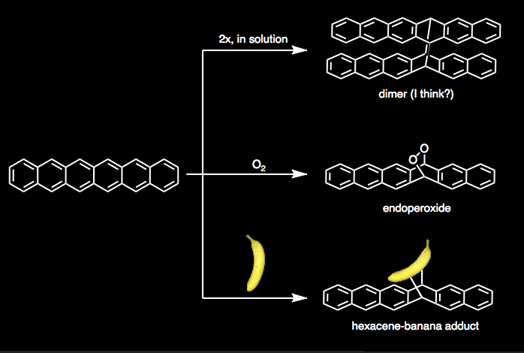
Hexacene is a green polycyclic aromatic hydrocarbon (PAH) with six fused, six-membered rings. In PAH's, the number and position of aromatic sextets (that is, benzene-like 6π electron systems) determines the reactivity of the PAH. As is the case with all linear acenes, such as naphthalene, anthracene, and pentacene, hexacene has only one aromatic sextet dispersed about the whole molecule. In other words, it's VERY reactive. It reacts with molecular oxygen readily, and will also rapidly dimerize to form a butterfly-looking molecule. It will even react with bananas.*


(Ψ*Ψ may want to school me on what the dimer actually looks like.)

You might be wondering how one even goes about these long, linear acenes. Well, hexacene is so reactive that the amount of information in the literature on it is scarce, and previous syntheses of it are inconsistent at best. Functionalized hexacenes of marginal stability have been synthesized and characterized, however. Nonetheless, these long linear acenes are of particular interest because of their interesting electronic properties and potential applications in organic field-effect transistors (oFETs).

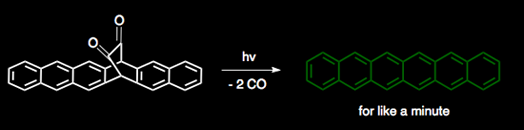
The Shah and Neckers groups at BGSU have found a nicer alternative to previous syntheses of hexacene, and even found a cute way to keep it around long enough to characterize it. Using a reaction known as the Strating−Zwanenberg photodecarbonylation as the final hexacene-making step, they were able to make hexacene in a paltry six steps. Hexacene only stuck around for a couple minutes in solution before deciding to dimerize or react with oxygen. It was long enough, however, to get a nice UV/Vis and mass spec on it. It's green! Whee!


A consistent synthesis of hexacene alone was probably enough to get this paper in Org. Lett., but then they went a step further. Incorporating the dione into a solid matrix of poly(methyl methacrylate) and irradiation formed hexacene. The polymer matrix kept the hexacene from dimerizing or reacting with oxygen for about 12 hours, until oxygen started to creep in.

So there you have it! Isn't aromatic chemistry FUN? Just remember one of Clar's findings if you deal with them: the prettier the PAH, the less likely it'll be around for long.

*Yes, this shit IS bananas. B-A-N-A-N-A-S.

5/11/2007

ring ring ring ring ring ring ring bananaphase?

Sometimes a good title for a paper is necessary. I find that sometimes if an article in an alright-but-not-super journal is on a subject that is somewhat outside my interests, it can appear worth reading even if I've never heard of the authors as long as it has a curious title. This can sometimes be accomplished by a single word.

Case in point: Electron Density Modulations in Columnar Banana Phases.

How often does a chemist use banana in a paper title? I did chance upon another Chemistry of Materials article from about three years ago that picked up on it first, to be fair.

(If you are me, bright colours in the graphical abstract also help.)

4/30/2007

The Big Bright Green Fluorescence Machine

Here at CBC, it is little surprise to anyone that we love conjugated polymers. Why do we love them, you ask? What is not to love? Their extended π-conjugation aids to warm our hearts, their structural rigidity brings us comfort, and their soft luminescence energizes our spirits. Conjugated polymers are the heart and soul of all that we love- they are the paradigm of the things we treasure in Nature. Haha, just kidding. We just like them cause they're pretty when they light up. In this way, they appeal to our basest instincts- I have basically picked a graduate program centered around things that look pretty on paper or in a flask. My long-wave UV lamp has, in this way, given me much satisfaction over these lonely years. I am little more than a john for the lipstick-wearing whore that is... solid-state fluorescence. Heidi Fleiss, eat your heart out.


Anyway. Science. My personal favorite conjugated polymer, one near and dear to my heart, is poly(p-phenylene ethynylene) (PPE)- a highly linear, rigid, conjugated polymer that crazy fluoresces pretty bluish-green in solution and in the solid state. Anything that makes pretty things fluoresce even better than normal is thus fair game for coverage here, and a group in Japan!* has managed to turn PPE into a luminatin' machine. But first, for the non-fluorescence croud, let me explain first fluorescence quantum yield.

It sounds like something straight out of, well, Quantum Leap, but quantum yield is a pretty simple idea. In happy ideal chemistry world, when one photon excites a molecule to a singlet excited state, one photon is released as the molecule relaxes to the ground state. That's fluorescence. Of course, as any of the students in my o-chem lab will tell you, happy ideal chemistry land is a crock of shit. Electrons can relax via many pathways, most non-radiative. In particular, conjugated polymers and other systems that have large pi-systems can form excited-state dimers (excimers- tee hee) or complexes (exciplexes) that cause electrons to prefer the non-radiative relaxation. The quantum yield Φ is simply a ratio of how many photons excite a molecule to how many photons are emitted. (Measuring Φ is trickier.) It's always less than 1. In the case of most conjugated polymers, it's waaaaaay less than 1.

Fortunately, the Yamaguchi group has found a way to greatly increase the fluorescence of PPEs, by adding π-acceptors to the polymer backbone. They've shown that boron functionalities, with their empty p orbitals, conjugate well with the π* orbital of the polymer and increase fluorescence activity. By alternating these π-acceptors with bulky functionalities with π-donors such as amines, fluorenes or carbazoles, the fluorescence quantum yield increases dramatically, both in solution and in the solid state.


If you read the paper, many of the conjugated polymers have quantum yields close to 1 in solution and close to 0.7 as films. (Since that fiasco with Shelley Batts, I am limiting the amount of crap I pull from the paper to pretty pictures. I don't need ACS's lawyers breathing down my necks right now. Maybe later, AFTER finals week at the very least.) It's not often you find quantum yields of 0.9 for conjugated polymers, so that's mightily impressive on paper.

Stay tuned next time, when I compare my interests in photonics to, I dunno, the firebombing of Dresden or something similarly inappropriate.

*I think it should be mandatory that when something cool comes out of Japan to refer to the country with at least one exclamation point, if not more (with some ones and eleventies thrown in for 1337ness) for example, when they started making robots: Japan!!!11!oneone!!111eleventy!11

4/26/2007

every now and then we need a serious post

I was searching for something-or-other recently and came across an interesting review by Jean Fréchet. It had all sorts of familiar structures.[1] I was very excited and knew I had to mention it here. But then I noticed some of the other articles. I'm about two weeks late in spreading the word, since it isn't something I usually read, but the current issue of Chem. Rev. (vol. 117 issue 4) is ALL ABOUT ORGANIC ELECTRONICS. (All apologies, but that totally called for screaming capital letters.) So, if you happen to read CBC but have no idea what the hell we're talking about unless it involves synthesis, here is a chance to become un-confused.[2, 3] I really have to point you to this one, maybe because I'm a photovoltaic fiend. I haven't had the chance to get through it yet, but every paper I've seen with Sariciftci's name on it has been extremely accessible and undergrad-friendly.

In other words, you should stop reading this and go read that.


[1] By "familiar" I mean I see some of them at least once a week in group meetings, and if I hear anything else about them, I might go nuts.
[2] I know there are several bloggers out there who fit this category. You know who you are!
[3] Is un-confused a word? I don't think it is, but it fits, so I'll use it.

4/20/2007

Slap-happy azobenzenes

If anyone came up to me and asked me, "Hey Excimer, what's your favorite functional group?" I would be very puzzled how they knew who I was based on my blog handle. But after questioning them NSA-style and maybe a little executive branch-approved torture (thanks PATRIOT Act!), I'd let them know that my favorite functional group is, in fact, the azobenzene group. (Then I would probably eliminate them.)

Azobenzenes are strange duckies. They are brilliant chromophores- azobenzene by itself is a strikingly bright orange, and functionalized azobenzenes, whose colors can range from yellow to blood red, take up a portion of the so-called FD&C (food, drug and cosmetics) dyes. Perhaps more striking than azobenzene's pretty color is their ability to photoisomerize. Azobenzenes can cis/trans isomerize in the presence of light. Under ultraviolet light, trans-azobenzene isomerizes to cis-azobenzene; under blue light, the reverse occurs. cis-azobenzene can thermally relax to the trans-isomer in the dark as well:


This strange property of azobenzenes makes it a curious material for various applications, which are numerous and I can't find my favorite examples at the moment (maybe for another post). The Zink group at UCLA exploited this isomerization in their latest J. Phys. Chem. C paper on ASAP right now. In it, azobenzene-functionalized mesoporous silica nanoparticles (with 2 nm pores) were embedded with the dye molecules Rhodamine 6G or Coumarin 540A. To keep the dye molecules in the pores, the pores were capped with 1 nm-large dendrimer-functionalized azobenzene. Irradiation at 457 nm causes both cis- and trans-azobenzene to isomerize, flopping back and forth between states and essentially slapping the dye molecules out of the pores.


I like to think of it as one of those obstacle courses on American Gladiators where you, as the dye molecule, have a bunch of padded bats (the azobenzenes) flying at you while you're trying to escape, and then Ice tries to take you out with her tennis ball machine gun. Or something.

It's a crazy idea, but it actually works, based on luminescence spectra. Only when the system is irradiated with light that can isomerize azobenzenes do the dye molecules actually leave the pores they are trapped in. This is yet another example of the applicability of azobenzenes in so-called molecular machines- there are lots of really awesome similar ideas out there in the literature, and, God willing, some of them might actually end up being useful; and, God willing, I'll find the time to find those examples I like so much and fawn over them here.